
I’ve stopped measuring travel by how many places I visit and started measuring it by how deeply I experience them.
There was a time when travelling meant moving.
Move to the next lookout.
Move to the next town.
Move to the next photograph.
I would pull into a location, lift the camera to my eye, capture the scene, glance at my watch and start thinking about where I needed to be next.
The day had a schedule.
Every location had a purpose.
Every stop needed to be ticked off before sunset.
Marie would often remind me that I wasn’t leaving much room for spontaneity.
At the time, I thought she simply enjoyed travelling differently.
Now I think she understood something I hadn’t yet learned.
Somewhere over the years, my relationship with travel quietly changed.
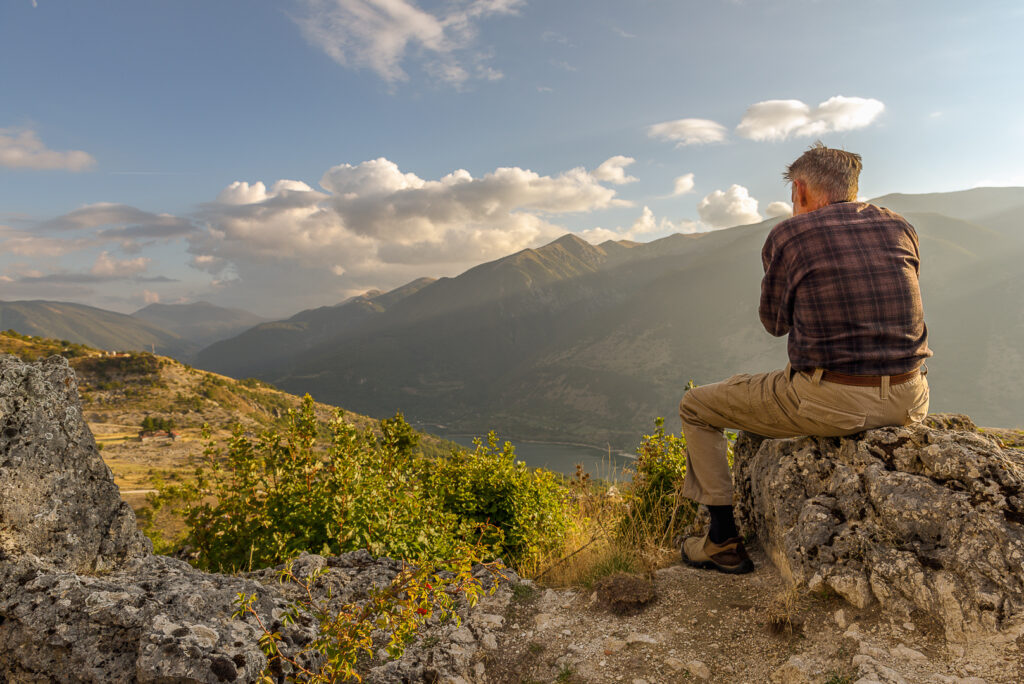
These days I am just as happy sitting quietly overlooking a landscape, walking slowly along a beach, or returning to the same café several mornings in a row.
I no longer feel the need to fit everything into a limited amount of time.
And strangely, the fewer places I try to experience, the richer those experiences become.
We Are Taught to Collect Experiences
When I look through travel brochures today, I notice how carefully every hour is planned.
Breakfast.
Cathedral.
Museum.
Lunch.
Scenic lookout.
Historic village.
Dinner.
Tomorrow begins again.
I understand the appeal.
Many people have limited time and want to experience as much as possible while they have the chance.
If we’re travelling halfway around the world, it seems sensible to see everything we can.
I’ve travelled that way myself.
The difficulty is that travel can quietly become an exercise in collecting experiences rather than living them.
Bucket lists encourage it.
Social media reinforces it.
Success begins to look like quantity.
The more countries, landmarks and photographs we accumulate, the more successful the trip appears.
But accumulation and experience are not the same thing.
The Problem With Trying to See Everything
When my itinerary became too rigid, my attention became divided.
Part of me was standing in front of a beautiful landscape.
Another part was calculating how long I had before I needed to move on.
I was physically present but mentally somewhere else.
The result was surprising.
The trips became harder to remember.
Sometimes I needed my itinerary just to recall where we had been on a particular day.
The photographs reminded me of locations.
They did not always remind me how those places felt.
Yet a single afternoon wandering away from the tourist district often remains vivid years later.
No famous landmark.
No checklist.
Just the experience of sitting in a café with locals, walking unfamiliar streets or discovering somewhere I never intended to visit.
The paradox became impossible to ignore.
The more I tried to see, the less I seemed to notice.
Photography Taught Me a Different Lesson
Early in my photographic journey, I chased famous viewpoints and iconic locations.
There was satisfaction in adding another celebrated place to my collection.
Then an experienced photographer asked me a simple question.
“How can you photograph something familiar in a way that feels personal?”
That question stayed with me.
At first, I spent longer working the scene from the popular viewpoint.
Eventually, I realised the more interesting photographs often existed beyond the obvious location.
A laneway covered in graffiti.
A neighbourhood café filled with locals.
An old doorway catching the afternoon light.
A conversation with a resident that led to a place no guidebook mentioned.
Photography gradually stopped being about collecting images.
It became a way of paying closer attention.
Why Depth Becomes More Appealing With Age
As I grow older, I find myself valuing depth over accumulation.
Achievement once motivated much of my life.
Now attention feels more valuable than achievement.
Connection feels more rewarding than accomplishment.
There was a time when sitting quietly watching waves break against rocks felt unproductive.
Today it feels restorative.
Perhaps many of us reach a stage where we stop asking how much more we can fit into life and start asking how deeply we can experience what is already there.
From conversations with friends of a similar age, I suspect I am not alone.
Many seem less interested in collecting moments and more interested in inhabiting them.
My Travels Look Different Now
These days Marie and I stay longer and travel more slowly.
Returning to the same place allows us to notice changes in light, weather and atmosphere.
Places reveal themselves gradually.
Without a checklist, curiosity has room to grow.
I find myself drawn to details I would once have walked past.
My photographs become more meaningful because they emerge from experience rather than urgency.
I am not suggesting this is the right way to travel.
It is simply the right way for me.
The Same Lesson Applies to Life
Looking back, much of my younger life was built around accumulation.
More possessions.
More achievements.
More commitments.
More experiences.
Eventually I realised that adding more no longer brought the satisfaction it once had.
Instead, fulfilment arrived through something quite different.
Deeper friendships.
Longer conversations.
Greater understanding.
Being fully present with the people and places that mattered.
Travel simply became another expression of that same lesson.
Closing Reflection
As I write this, I am sitting on my balcony looking out to sea.
A ship moves slowly across the horizon.
Children are playing on the beach.
A handful of surfers wait patiently for the next wave.
My camera rests on the table beside me.
There is no urgency to pick it up.
For a while, I simply watch.
Then one surfer catches a wave and performs a series of graceful manoeuvres.
Only then do I reach for the camera.
I make the photograph because I was present long enough to see it happen.
Perhaps that is the lesson age has been trying to teach me all along.
Slowing down does not mean there is less to discover.
It means there is finally enough time to truly see what has been there all along.
Originally published in Full Frame, The Art of Photography