
The places we return to may remain much the same. The person returning never does.
Marie and I have visited Noosa Main Beach many times over the years.
It is one of Australia’s relatively rare north-facing beaches, with sheltered water at one end and Noosa National Park beginning at the other. Over the years, it has become increasingly popular with locals and visitors.
The Surf Life Saving Club has a bistro overlooking the beach, and we have often sat there for hours watching the people and the waves.
Towards the National Park, surfers gather in the water, waiting for the right wave. On the sand, families spread out towels, children play, and people wander towards the water.
It is a scene I know well.
And yet I wonder sometimes why the same place can feel completely different each time we return.
The sand hasn’t changed very much.
Neither has the ocean.
The waves still arrive. The tide still comes and goes. The horizon is where it has always been.
Yet a place we have known for years can somehow feel new.
Not necessarily because the place has changed.
Because we have.
I’ve gradually come to understand that photographs don’t simply record the world in front of us.
They also quietly record the person we were when we looked at it.
We Imagine the Camera Is Objective
I once thought of my camera primarily as a tool for documenting where I had been and the people I was with.
Like many people, I assumed photography captured reality.
There was some justification for thinking that way. Photographs are used as evidence. They document events. They preserve appearances. We look at an old photograph and say, “That’s what it looked like.”
Technically, a camera captures light.
But emotionally, photography captures something else.
Attention.
What did I notice?
What made me stop?
Why did I point the camera in one direction rather than another?
Why did I include one thing and leave another outside the frame?
As I became more interested in photography, I began to understand that these decisions say at least as much about the photographer as they do about the subject.
Marie and I can stand beside each other looking at exactly the same scene and rarely make the same photograph.
I might photograph the sweep of the beach and then turn my attention to a surfer riding a wave.
Marie might notice two people deep in conversation. Or she might see the movement of children running into the water and imagine how she could express that movement through a multiple exposure.
Same beach.
Same moment.
Different photographs.
We aren’t seeing different places.
We are bringing different histories, interests, memories and ways of seeing to the same place.
Now I understand photography as a conversation between the world in front of the camera and the person standing behind it.
And that person doesn’t remain the same.
The Beach at Twenty
When I think about the beach as a younger man, I remember a very different place.
At twenty, the beach seemed full of possibility.
Even driving there could feel exciting. It felt like getting away from normal life and going somewhere associated with freedom.
Friends.
Romance.
Swimming.
Movement.
Adventure.
The beach was somewhere things happened.
Had I been serious about photography then, I suspect my camera would have followed that energy.
People laughing.
Surfboards.
Sunsets.
Bodies moving through the water.
An endless horizon suggesting that there was always somewhere else to go.
I would have been photographing what I was experiencing because that was what mattered to me.
What I probably wouldn’t have photographed was just as revealing.
The weathered timber.
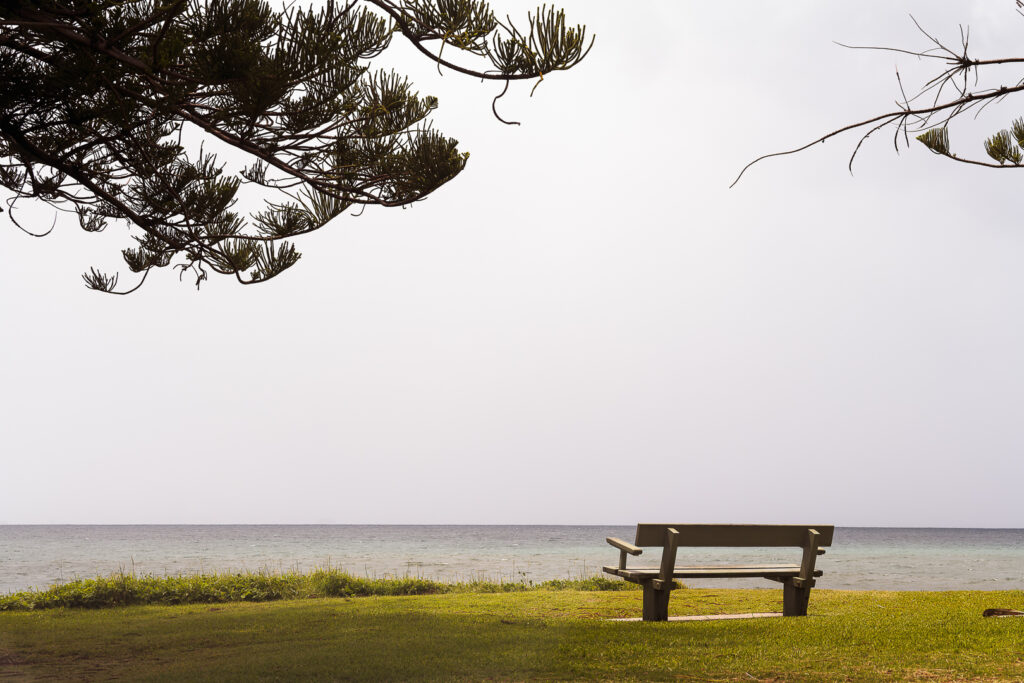
An empty bench.
Patterns left in the sand by the receding tide.
Someone sitting quietly looking towards the horizon.
Those things were already there.
I simply wasn’t ready to notice them.
The Same Beach After Marriage
Marriage changes the way we occupy places.
A place that once represented independence and possibility can gradually become somewhere associated with a shared life.
The beach became part of that for me.
There were family outings. Children, nieces and nephews building sandcastles and playing at the water’s edge. Holidays. Anniversaries. Familiar places revisited because they had become part of our story.
Without consciously deciding to do it, the emphasis of my photographs changed.
The scenery was still there, but increasingly it became the background.
The people mattered more.
A beach was no longer simply an attractive stretch of sand beside the ocean. It became the stage on which parts of our lives unfolded.
Looking back, I don’t think the beach itself had become more meaningful.
My life had.
And because my life had changed, I brought something different to the place.
The Same Beach After Loss
Then another change eventually enters most lives.
Absence.
People leave our lives for all sorts of reasons. Relationships change. Parents and friends grow older. Some people die. Places associated with particular people can remain long after those people are no longer part of our everyday lives.
And absence can change what we notice.
A place once remembered for laughter may suddenly seem quieter.
An empty bench can become more noticeable than the people walking past it.
A familiar path can remind us of someone who once walked beside us.
Late afternoon light can suddenly carry a feeling that it never seemed to possess before.
Nothing necessarily changed in the landscape.
What changed was what we brought to it.
Perhaps loss makes us more conscious of what isn’t there.
It can slow our attention and make ordinary things carry meanings they didn’t have before.
The beach hasn’t changed.
But the questions we ask of it have.
The Same Beach After Retirement
And then came retirement.
For most of my working life, time had structure imposed upon it.
There were deadlines. Appointments. Responsibilities. Places to be and things to do.
Retirement removed much of that structure.
That took some getting used to.
But gradually something interesting happened.
I stopped feeling quite so much urgency.
And as I slowed down, I began noticing things that had probably been there all along.
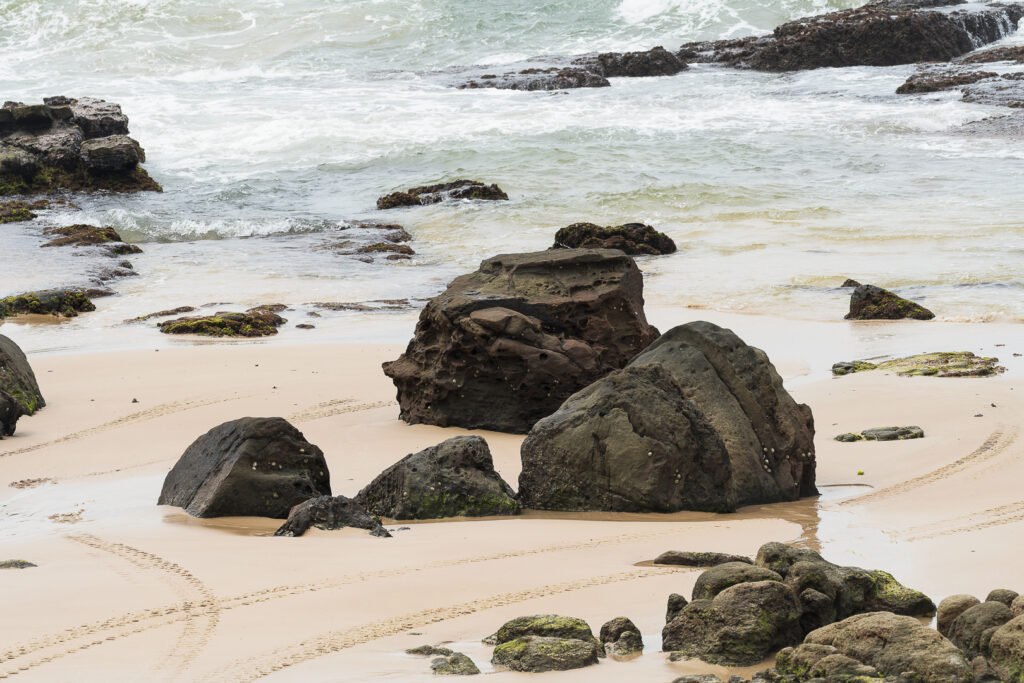
Patterns in rocks.
Weathered timber.
Birds wandering along the shoreline.
Reflections.
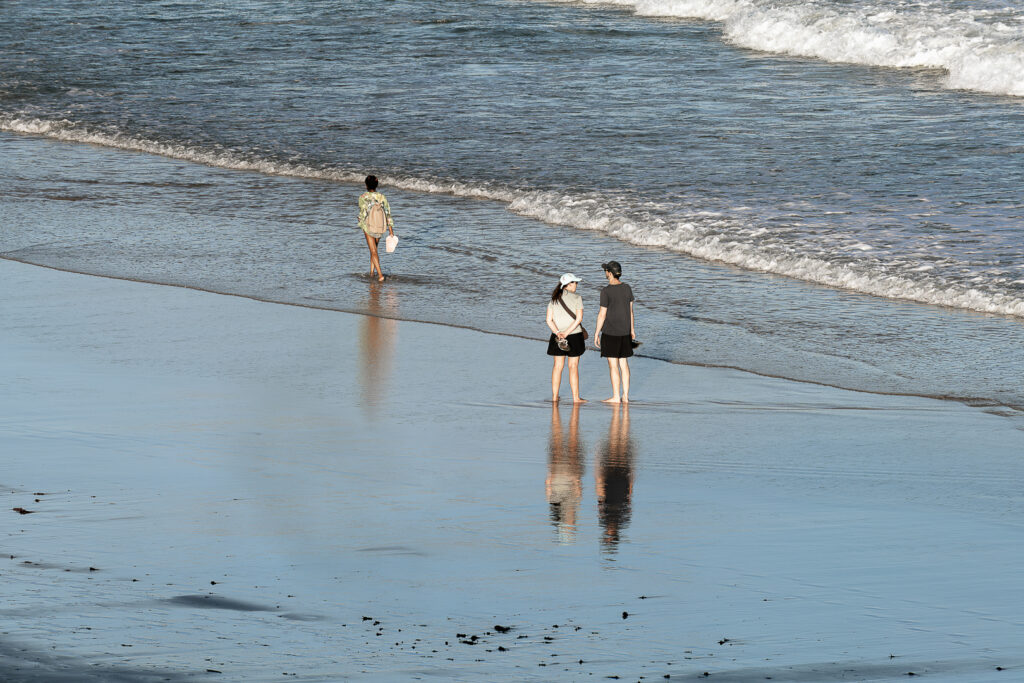
Quiet conversations between people who didn’t know they were being observed by a photographer.
The changing tide.
Marks in the sand that would disappear with the next wave.
None of these things had suddenly become interesting.
I had become interested in them.
Perhaps that is one of the gifts of getting older. We don’t necessarily see more.
We may simply become more willing to spend time with what we see.
I stopped feeling that every photograph needed a landmark or an obvious subject.
Increasingly, I began looking for something else.
Meaning.
What Photography Quietly Reveals
There was a time when I thought becoming a better photographer was largely about equipment and technique.
A better lens.
More megapixels.
A camera with greater dynamic range.
More information to work with in Photoshop.
And, of course, equipment and technique matter. They expand what we can do.
But I’m no longer convinced they are responsible for the most important changes in a photographer’s work.
Those changes happen somewhere else.
When I look back through photographs made at different stages of my life, I can see changes that have little to do with the camera I was carrying.
My photographs have gradually become quieter.
Simpler.
More patient.
I leave more space.
I’m increasingly interested in ordinary places and small moments that I might once have walked past.
The world didn’t suddenly become quieter.
I did.
Perhaps that is what photography eventually reveals to us.
At first, we think we’re making photographs of landscapes, people, buildings, beaches and streets.
Years later, when we look back through them, we discover something else hiding among all those photographs.
Ourselves.
The Photograph Changes Because We Do
Another consequence of this is one I find fascinating.
Old photographs don’t remain fixed.
The pixels don’t change, of course. What was inside the frame when we pressed the shutter remains there.
But our relationship with the photograph can change completely.
A photograph that once seemed unimportant can become precious because someone in it is no longer with us.
A photograph we once valued for its technical impressiveness may eventually leave us cold.
An ordinary photograph of a house, street or beach can become more meaningful with every passing year.
We look at the same photograph with different eyes.
The twenty-year-old sees one thing.
The newly married person sees another.
The person who has experienced loss sees something else.
And the retired photographer looking back across decades of photographs brings an entirely different life to them.
Perhaps photographs don’t preserve moments quite as completely as we imagine.
They preserve something for our future selves to rediscover.
The Same Beach, Seen Again
I’m standing on Noosa Beach.
The sun is shining, and a gentle breeze comes off the water.
Families are beginning to arrive. A few people are swimming. Further along, surfers wait for waves.
I’ve seen versions of this scene many times.
The beach is familiar.
The waves are familiar.
The tide is familiar.
The horizon is familiar.
Yet my experience of it is not.
I notice different things now.
I linger over things I might once have ignored.
And sometimes I make photographs that the younger version of me would probably never have thought worth making.
The world has been patiently waiting all along.
It wasn’t asking me to become a better photographer.
It was waiting for me to become a different person.
Perhaps that’s why our oldest photographs can keep changing long after we’ve finished making them.
The places may remain remarkably similar.
We never do.
Originally published in Full Frame, The Art of Photography