
The most meaningful travel memories are rarely on the itinerary.
In 2017, Marie and I travelled through Italy with a small group of photographer friends. The itinerary included many of the country’s well-known locations, but there was also enough freedom to wander beyond the tourist trail.
One of our stops was Paestum, famous for its remarkably preserved Greek temples and its buffalo mozzarella.
Like everyone else, we photographed the temples. We visited a buffalo farm. We ticked the boxes.
Yet when I think about Paestum today, those are not the memories that come first.
Instead, I remember wandering into the township with Marie. We walked down a short main street that eventually led to a quiet beach with only a handful of people on it. Along the way, I stopped in front of a shop called Indiana Jones, Shuvo + Mamma. The sign featured Harrison Ford holding his trademark whip.
The shop was closed, so we never discovered what was inside.
Strangely, that small moment has stayed with me more vividly than the temples.
Experiences like this have taught me something about travel, photography, and perhaps life itself.
We often arrive looking for the headline attraction while overlooking the quieter experiences that give a place its character.
The Way Most of Us Travel
Whenever Marie and I plan to visit somewhere new, one of the first things we do is research what the location is known for and what photographs we might make there.
The process is useful. It helps us understand the history, the landmarks, and the experiences that draw people to a place.
But there is a downside.
Without realising it, we can turn travel into a checklist.
Guidebooks, travel blogs, YouTube videos, and social media all tell us what matters. So we build a list:
- the famous lookout
- the cathedral
- the monument
- the iconic building
There is nothing wrong with visiting these places. They often deserve their reputation.
The problem comes when our schedule becomes so focused on the must-sees that we leave no room for discovery.
I’ve done that more than once.
I’ve rushed from one location to another, collecting photographs while barely experiencing the place itself.
The irony is that the moments I remember most rarely come from the checklist.
They come from the spaces between the items on it.
The Difference Between Seeing and Noticing
Photography has taught me there is a difference between seeing and noticing.
Seeing happens automatically.
Noticing requires intention.
Most of us see thousands of things every day. We scan rooms, streets, landscapes, and faces without giving them much thought.
When I slow down with a camera, something changes.
I begin noticing the texture of old stone walls. The patterns created by worn pathways. The way afternoon light falls across a doorway.
Colours become more vivid.
Details emerge.
A cloud formation suddenly resembles an animal. A cracked wall tells a story. A reflection creates an unexpected composition.
Then there are the human moments.
A couple sharing coffee and conversation.
Parents interacting with their children.
Someone stopping to pat a dog.
Two people walking hand in hand.
These moments are easy to miss when we’re rushing toward the next attraction.
When I pay attention, I start seeing relationships rather than objects.
A bridge becomes more than a bridge. I notice how it is supported, how it shapes the landscape, and how people use it.
The place begins to reveal its personality.
And that personality is often what makes it memorable.
The Places That Stay With Us
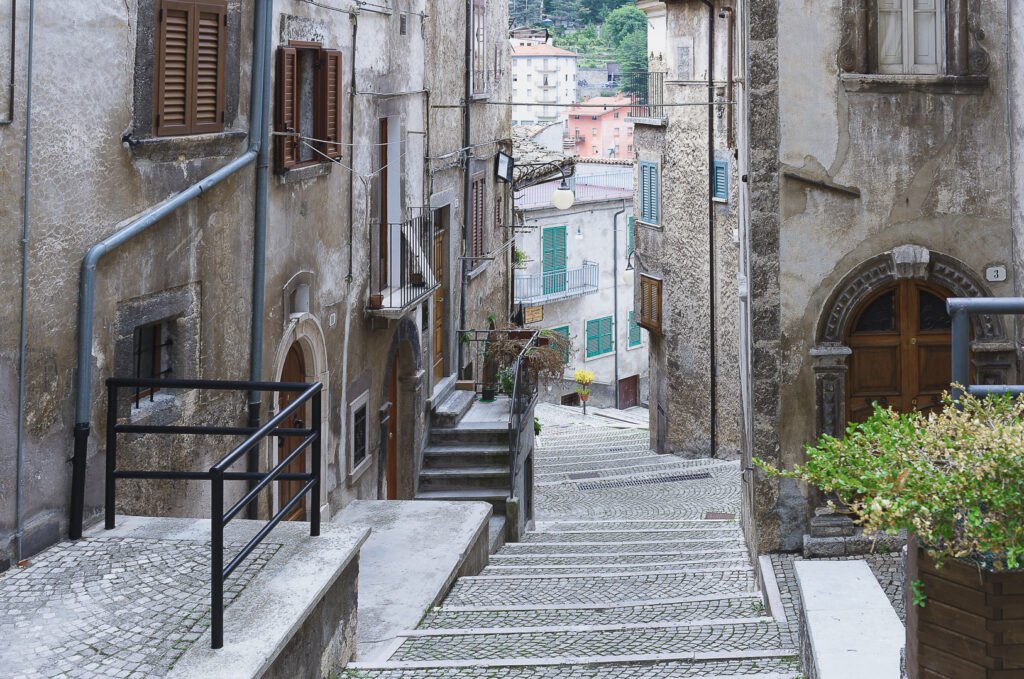
One reason Marie and I visited Scanno in Italy was to stand where Henri Cartier-Bresson created one of his most famous photographs. We also wanted to photograph the traditional costumes for which the town is known.
Yet my strongest memories are not of either of those things.
What I remember are the stone pathways, the weathered buildings, and the endless stairways winding through the town.
I remember exploring narrow lanes that seemed to lead nowhere.
I remember turning a corner and finding a simple pot of bright yellow flowers sitting beside a staircase that disappeared from view.
There was nothing remarkable about it.
And yet it remains one of my clearest memories.
The same thing happened in Stanley, Tasmania.
Most visitors arrive to see The Nut, the dramatic volcanic plug rising above the town.
It is certainly impressive.
But my most memorable experience came just outside town, where Marie and I discovered the partial ruins of an old building beside the road.
We spent nearly half an hour there.
No crowds.
No tour buses.
No famous landmark.
Just a quiet place that invited us to stop and pay attention.
I’ve realised that the experiences that stay with me usually contain an element of surprise, discovery, or personal connection.
The famous landmarks help tell the story of where I’ve been.
The unexpected moments become the story itself.
Photography Changed How I Travel
I’ve carried a camera for most of my life.
For many years it was simply a tourist camera used to document my travels as I moved from one attraction to the next.
When I visited New York in my twenties, I photographed all the places visitors are supposed to photograph. After returning home, I had the film developed and printed.
One photograph affected me emotionally.
At the time, I didn’t understand why.
It would take many years before I began to appreciate that photographs can carry emotions, memories, and meaning far beyond the subject they depict.
As my photography evolved, so did the way I travelled.
I became less interested in collecting images and more interested in experiencing places.
I stopped worrying about completing a checklist.
Instead, I began exploring, observing, waiting, and allowing curiosity to guide me.
The camera became less of a recording device and more of a tool for paying attention.
Closing Reflection
Over time, I’ve come to realise that the best part of a place is rarely hidden.
More often, it is sitting in plain sight, waiting for someone to notice.
These days, when Marie and I visit somewhere new, we still photograph the landmark. We still enjoy the attraction.
But we also leave room for wandering.
We walk one street further.
We pause a little longer.
We look around the corner.
That is often where the real experience begins.
My experience has been that the memory that stays with me is rarely the place I travelled to see.
It’s the place I almost walked past.
I write and create around presence, time, and the quieter ways we live with images. If this reflection resonated, you may find similar moments in my photography.
Originally published in Full Frame, The Art of Photography
Interested in a print of this photo? Get in touch.